

Want your emails actually read and acted on? In this guide, you’ll learn exactly how to structure an email — subject line to sign-off — so busy people grasp your point in seconds and can reply with a simple ‘yes’ or ‘no’.
Email remains one of the most important ways to communicate with clients, customers and fellow team members. But inboxes are crowded and to-do lists never end, so a clearly written email is what gets your point heard — and answered first.
Quick answer: the four rules of a really good email
- Decide the outcome you want before you type a word.
- Write from the recipient’s perspective: what do they need to know, and what makes their action easy?
- Keep it short — clear subject line, one point per line.
- Ask for a simple yes/no decision, with owners and deadlines in bold.
One more thing before we dive in: AI assistants can now draft a passable email in seconds. Use them by all means — but the principles below are what turn a passable draft into one that gets a decision. You still need to know what outcome you want, what the recipient needs, and how to make the ask effortless.
What to consider before writing an email
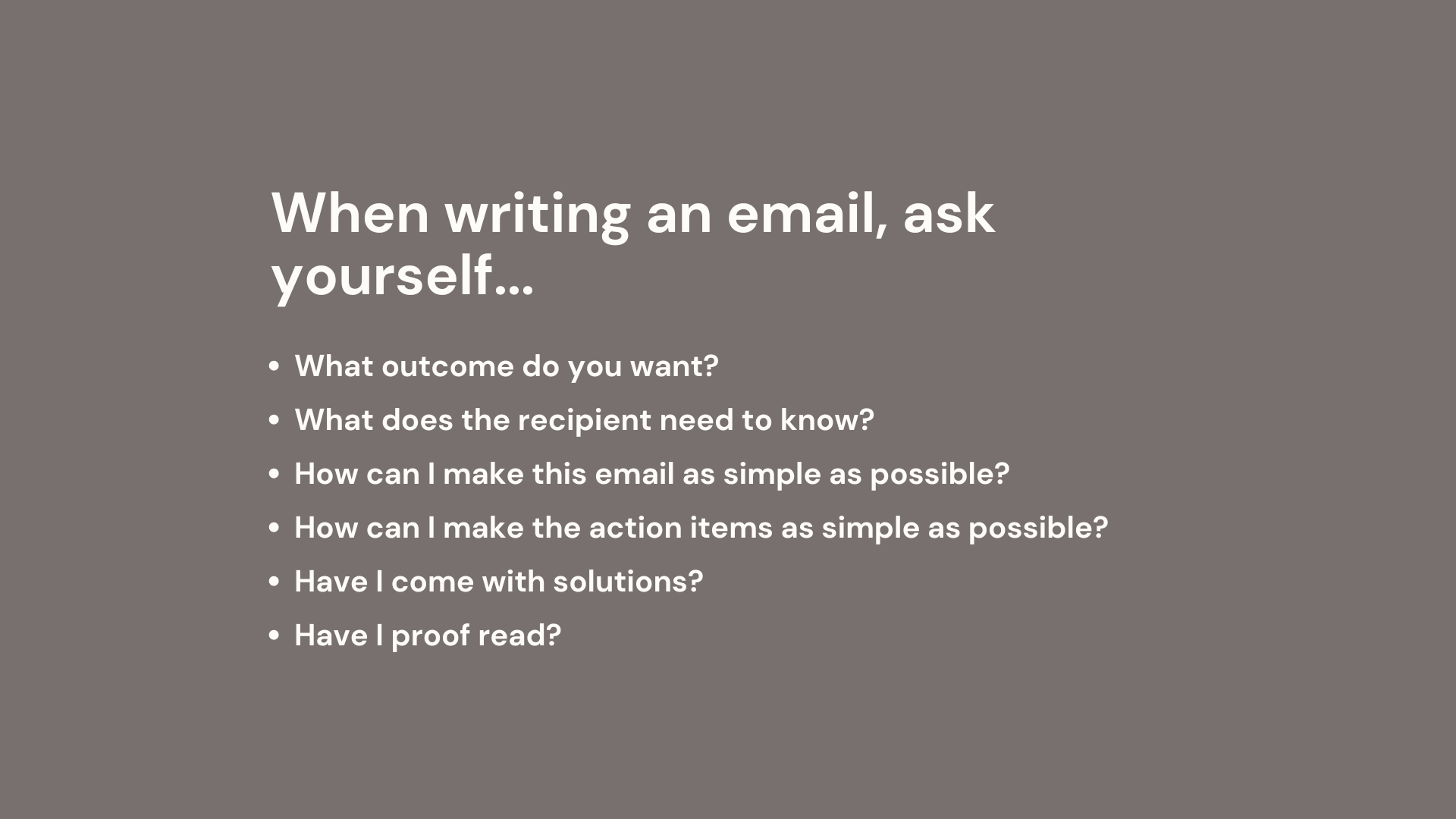
What outcome do you actually want from the email?
- Brainstorm this first as it will guide the overall direction and tone of the email. This is critical.
Think about email from the recipient’s perspective.
- What do they need to know?
- How can we make it as simple for them to understand as possible?
- How can we make actions on the back of the email as simple as possible to understand and for owners to complete?
- If there is anything for them to check, e.g. a website. Make sure to put the link within the email - you should make actions as easy as possible for the recipient to complete whatever you need of them.
- Wherever possible, come with solutions and give the email reader/decision-maker a simple 'yes' or 'no' reply.
To reiterate: High-quality punctuation and grammar matter. Consistent formatting matters.
- Why? It shows you've read your work through carefully and care about what the other person sees.
How to structure an email that gets read ✔️
- Give a very clear, precise subject. Be sure to update the subject if necessary as the chain evolves.
- Keep emails as short as possible. People are busy and appreciate brevity.
- If sharing notes from a meeting, don’t simply share everything. Only share what’s valuable and get rid of the waffle.
- If authoring a longer email, set the agenda at the beginning and give a couple of summary paragraphs. Indicate there is more detail below the sign off.
- Finally, sign off e.g. ‘Thanks, xxx’, and then put the more detailed outline below that will help the stakeholder come to a decision if they need it.
- This way, the stakeholder quickly understands the purpose of the email, and can easily progress into the more detailed part. In doing this, you have given them the option to read more, but have given them enough to understand the crux if they are short on time.
- Wherever possible, keep to one point per line as it makes emails far easier to read.
- Do use common sense when applying this. If there is simply too much to include in the email, don’t draft an email of 700 lines but do try to keep each line as simple and clear as possible.
- For emails that cover several areas, clearly denote the main areas with the use of CAPITALISED, EMBOLDENED TITLES.
- For sub-headings, use Emboldened titles.
- Finally, write out the points within them as normal.
- Try to maintain perfect consistency in using this email structure as stakeholders will get used to, and hugely appreciate, the way you operate.
How to ask for a decision by email
Always give instructions on what specifically is needed.
- Outline why the decision matters and what it affects.
- Make the most important factors in a decision as clear as possible.
Suggest what you think the correct decision is and why. Making suggestions is essential as it:
- Ensures you come with solutions not just problems; stakeholders love this as they have enough to think about already.
- Puts you in the shoes of that person and their role increasing your empathy for them.
- Gives you practice at being the shot caller.
- Is your chance to influence and that’s critical.
Give the stakeholder a simple ‘yes’ or ‘no’ decision wherever possible.
- How? By doing the above and suggesting what you think and simply asking if they agree/disagree or if you should do this/don’t do this.
- Action points should have a clear owner, with deadlines in bold.
Proofread before you hit send
- Re-read the full email before sending it — out loud, if it’s an important one.
- This is especially important for emails that start a big chain with a number of people on a new project and cover important issues.
- Put yourself in your stakeholders’ shoes. Would you have any immediate/obvious questions?
- If so, try to answer them within this original email to increase efficiency, and avoid a back-and-forth within the email chain.
- Listen to the whisper inside of you here. Turn it up. I promise you that ignoring your instincts will just lead to a painful email back-and-forth later.
- Why? People's own replies will almost always be poorly structured and quickly sent back, confusing anyone else on the chain and ultimately detracting from all your hard work in getting your original email really tight.
Good written communication skills are relevant to everyone…
So, that’s a quick rundown of the ways we find it best to write really good emails, both internally and externally at Mindlace.
These tips come from many years managing hard and complicated projects, for different companies, and teams of varied disciplines and contexts.
However, no matter what your company size, our guidelines for writing effective emails remain the same. Prioritise clarity and efficiency to get the most out of your writing, both for yourself and your clients.